11.17.25
AI and the Death of the Generic Brand Voice: Why your audience can tell when your captions were written by a robot and what to do about it.
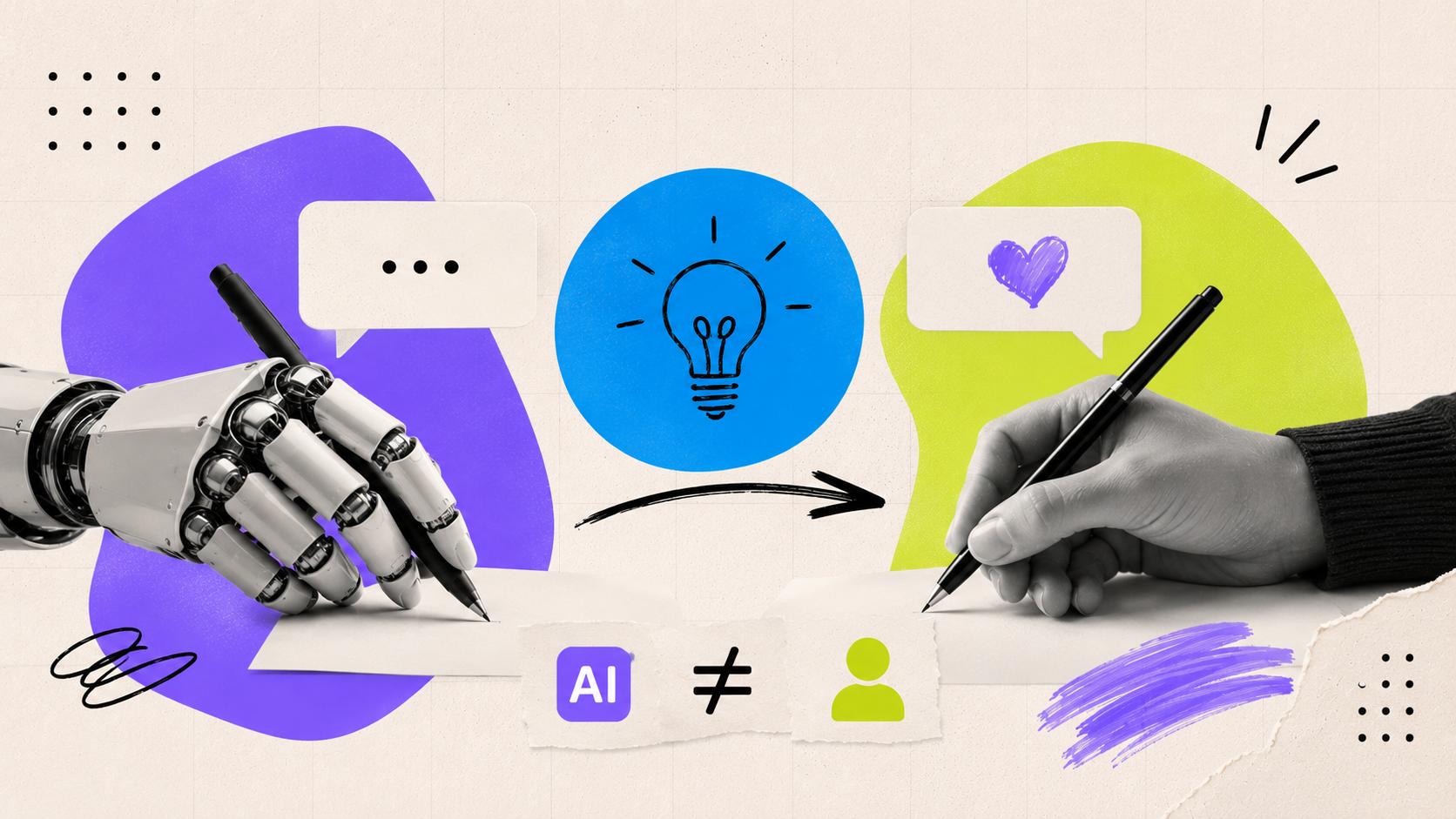
Have you been scrolling through your feed lately and noticing that everything is starting to sound the same? “Here’s your Monday motivation.” “Don’t forget to follow for more tips.” “Level up your strategy in 2026.” It’s all polished, professional and painfully familiar.
AI tools have made it easier than ever to generate content at scale. What used to take hours now takes seconds. But that convenience comes with a cost: redundancy. When every caption, headline, and email starts to feel like it came from the same template, your brand’s voice, the very thing that once set you apart, starts to disappear into the noise. For brands that have worked hard to build an identity, that is a problem.
The Convenience Trap
The explosion of AI writing tools was inevitable. Every marketer felt the pressure to “produce more.” AI offered a lifeline. A way to keep up with algorithms, deadlines, and endless content demands.
Most AI systems are designed for efficiency, not originality. They prioritize grammar, clarity, and general appeal. They’re built to satisfy the average, not express the unique. And when social teams and agencies rely on default prompts like “write an Instagram caption about our new product,” the result is predictably bland. The output sounds professional, but also extremely generic.
A quick comparison makes the point clear. The AI version of a product announcement might read: “Exciting news! Our latest launch is here. Discover how it can help you achieve your goals today.”
A human version might say: “You asked for it, we built it. Meet the update that makes your Mondays a little smoother.”
One sounds like every brand. The other sounds like yours.
What started as a shortcut has quietly replaced distinctiveness with efficiency. Brands have traded creativity for convenience and the audience can feel it.
What Your Audience Notices (Even If You Don’t)
Audiences may not always know why something feels off, but they can tell when it does. The shift is subtle. A caption that’s too polished, a post that lacks warmth, a message that hits every keyword but no emotional chord. Tone, humor, rhythm, even the pauses in how you write, these are the cues that signal authenticity.
AI can mimic style, but it can’t replicate empathy. It doesn’t know how to hold back on the joke that’s just a little too corporate, or when to speak with heart instead of hype. It can’t feel the pulse of your culture or the inside jokes that make your audience feel seen.
And then there are the smaller tells such as punctuation. One of the easiest giveaways that AI had a hand in your copy is the overuse of the em dash. Humans use it sparingly, while AI uses it constantly. It has been trained to see it as a sophisticated way to connect ideas. But when every other sentence includes one, it stops reading like a person and starts sounding like a program. The nuance of pacing is something algorithms still don’t get right.
We’ve seen brands backtrack after AI-generated missteps, captions that feel tone-deaf, posts that miss the cultural moment, or stories that sound suspiciously synthetic. It’s not malicious. It’s just mechanical. And when your voice loses its human touch, people stop listening.
Take Coca-Cola’s 2024 Christmas AI ad, for example. The campaign, which used artificial intelligence to generate visuals meant to celebrate creativity, ended up sparking backlash for its distorted imagery and lack of emotional depth. What was intended as a cutting-edge experiment came across as cold and disconnected. A reminder that even iconic brands can stumble when technology outpaces authenticity.
Keeping the Voice Human
Smart brands aren’t rejecting AI, they’re redefining how they use it. The goal is to make it serve your brand’s humanity, not erase it.
That starts by defining your voice. Document what your brand sounds like when it’s confident, empathetic, or playful. Capture your rhythm, your slang, your sense of humor. If your audience could hear your brand as a person, who would it sound like?
Next, train the tools to mirror your tone, not a generic one. Feed AI examples of your best-performing posts and campaigns so it starts learning your language patterns. Think of it less like outsourcing and more like onboarding.
Finally, use AI as a brainstorming partner, not a ghostwriter. Let it help you find ideas, not write your story. And always, always add a human edit. The finishing touches can come from a machine, but the real substance must come from a person.
AI can assist your team. It just shouldn’t replace them.
The New Advantage: Authenticity at Scale
Here’s the irony: as AI floods every corner of the internet with perfect, generic content, authenticity has never been more powerful. The brands that win won’t be the ones that sound flawless, they’ll be the ones that sound real.
AI isn’t the death of creativity. It challenges brands to get clearer about who they are and what makes them different. Use AI to enhance your voice, not flatten it.
At Iron Roots, we believe the future of digital marketing isn’t less human. It’s more intentional.